How Denver gave birth to the cable, satellite TV, telecommunications industries

By Rosemary Fetter
Although cable TV debuted as early as in 1948 in Oregon, Pennsylvania and Arkansas, the industry really took off in 1953, when legendary entrepreneur Bill Daniels and Gene and Ray Schneider brought the first TV programming to Wyoming via a Denver-to-Casper cable system.
At the time, television was still in its infancy. The first coast-to-coast TV program aired Sept. 4, 1951, as President Harry S. Truman announced the final withdrawal of U.S. troops from Japan at a San Francisco conference. That year, Americans owned six million television sets. By 1955, half of all U.S. homes had a TV. Since remote areas had no way to access programming from this blossoming entertainment phenomenon, the cable industry emerged to fill the gap. By the late 1950s, 640 cable systems worldwide supplied TV to 650,000 American homes.
Originally, local entrepreneurs wired antenna and microwave to provide service to outlying areas, a primitive system that had several drawbacks. Meanwhile, Daniels, a genius at promoting cable, opened the first national cable brokerage firm in downtown Denver in 1957. A born salesman, he encouraged entrepreneurs Bob Magness (TCI), Glenn Jones (Jones InterCable), and Monty Rifkin (ATC, which merged with Time in 1979) to explore cable investments. Several companies moved their headquarters to the Denver South area (a.k.a. the Denver Tech Center area) which offered plenty of elbow room. With its clear skies, high altitude and generally mild climate, the area southeast of Denver provided the perfect setting for the booming cable/satellite-dependent industries.
Cable companies and municipalities were in a constant power struggle during the early years, the latter (lobbied by networks) seeking to control the industry and curtail its growth. To start their businesses, cable pioneers financed endeavors any way they could, borrowing from oilmen, pension funds, and even mortgaging personal property. Entrepreneurship bloomed in the fledgling telecommunications business. New deals were made, and companies traded and re-traded in a real-life version of Monopoly. According to the Greg Avery (Denver Business Journal, April 2009), “Cable executives collaborated with one another, partnered with innovators in media content, and invested in emerging technologies in order to survive.”
On October 1, 1979, cable entered a new era when HBO provided viewers with live action coverage of the Ali-Frazier Heavyweight World Championship, labeled “Thrilla in Manilla.” Cable subsequently evolved into a major entertainment forum rather than simply a means to connect remote areas to network TV.
The industry leaders were a special breed. Daniels, John Malone, Magness, Rifkin, Jones and Trygve Mhyren (former chair and CEO of Time Warner Cable) focused more on progress than profits and promoted an entrepreneurial spirit in the industry. In 1986, TCI (Magness and Malone) bought part of Group W, Westinghouse cable systems, whose CEO, Dan Ritchie, later became the president of the University of Denver. Through his influence, D.U. built the Cable Center, which houses the Cable Museum and Library, a major repository of material on the industry’s history. Connections in the cable industry led to multiple enhancements at the university, including the Ritchie Center, the Magness Arena, and the Daniels School of Business.
Eventually, competition from satellite and broadband mandated more expansive mergers in the cable constellation if the industry were to survive. In 1999, AT&T acquired TCI, then the country’s largest cable provider, in a $48 billion deal. CEO Malone then moved to Liberty Media Corporation, a separate company that included newer TCI businesses, renamed TCI Ventures. The merry-go-round continued to spin in May when AT&T bought Media One Group, Inc., a cable offshoot of U.S. West. In turn, two years later, Comcast bought AT&T cable holdings, once again becoming the country’s largest cable provider. The consolidation of cable helped AT&T and Comcast compete with satellite and telecom companies barking at their heels. In 2014, an attempted merger between Comcast and Time Warner failed to materialize.

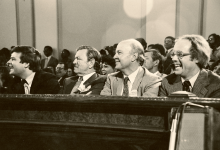
Photo courtesy DSEDP
Although Denver was undoubtedly the birthplace of cable TV, and for more than 30 years served as the cable capital of the world, the city proper held out until the early 1980s, mostly for political reasons. Although much of the action has moved to Philadelphia, some maintain that Denver is still the center of the cable industry, and telecommunications still plays a vital role in the state’s economy. Even after selling their companies, many of the cable pioneers, multi-millionaires several times over, extended their efforts into enterprises that were not far removed from their original endeavors, moving into areas such as international TV, internet, telecommunication companies and even real estate.