TABOR at center of legislature’s budgetary debates
By Peter Jones
Any discussion on Colorado’s state budget eventually comes around to TABOR, especially when a mix of Republican and Democratic legislators are around. The voter-approved Taxpayers’ Bill of Rights, which limits government spending without the OK of voters, is either the panacea to overreach or a strangulation on functional government.
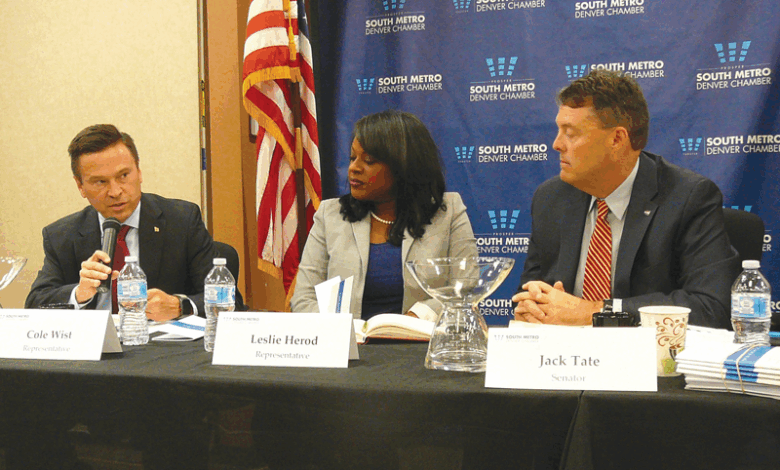
“We’ve started to cut away, not just at the fat, but the muscle and the bone. I think we’re all feeling that,” state Rep. Leslie Herod, D-Denver, told the South Metro Denver Chamber of Commerce on Oct. 18.
Herod, a plaintiff in a lawsuit challenging TABOR, told the chamber’s Business Leaders for Responsible Government that the 1990s-era state-constitutional amendment has effectively hamstrung what she called Colorado’s “crumbling” education and transportation systems.
“So, if we really truly want to invest in infrastructure in the state, we need to do something about TABOR,” the Democratic representative said. “… What we end up doing is shaving here and shaving there and really not doing the job at anything.”
Republican legislators on the panel, titled “Our State Budget … Solutions for Change,” disagreed. Rep. Cole Wist of Centennial adamantly defended TABOR, noting that taxes can always be increased with a simple affirmative vote of the people. He also noted that the now-$28.3 billion state budget has increased 45 percent over the last eight years.
“Imagine if your family was earning 45 percent more than it did eight years ago. I think you’d probably say you’re doing pretty well,” Wist told the room of business and civic leaders. “… Our government is simply growing too fast and spending too much money.”
Sen Jack Tate, R-Centennial, argued that TABOR’s system of voter approval had essentially affirmed a basic truth about government behavior.
“I don’t know if there’s ever been a case where the executive branch or any agency has ever come to the legislature and said, you know, we only need 95 percent of what we had last year,” Tate said.
Sen. Cheri Jahn, D-Arvada, countered that Republicans have consistently refused to let the voters vote up or down on proposed tax increases, arguably defying one of the basic tenets TABOR’s will of the people.
“Every single time we have tried to do that in the legislature, we can’t get it out of the body to send it to the people to vote on,” she said, noting TABOR-instituted refunds have been as little as $14. “That money could have been used for transportation. … It’s kind of damned if you do, damned if you don’t.”
Although the budget is technically greater than $28 billion, lawmakers on both sides of the aisle stressed that the legislature has far less than that—about $11 billion—to actually allocate after legally-bound funds are removed from the discretionary balance sheet.
Rep. Bob Rankin, a northwestern Colorado Republican, was the only panelist who serves on the General Assembly’s six-member Joint Budget Committee, which he called the legislature’s most bipartisan body.
“We get the governor’s recommended budget the first of November and we go to work,” he said. “In about March, we go present that to the legislature and they start to pay attention and run a lot of screwy things.”
Special interests and pressure come next, according to the legislator
“It’s about a thousand little spending items. Some are big. Some aren’t. And every one of these things, believe me, there’s a lobbyist or advocacy group waiting outside of the Joint Budget Committee with a really convincing story,” Rankin said.
Enter the world of partisanship, which all said influences the process
“I think everyone in this room would agree that’s part of the problem,” Jahn said. “Politics seems to be in everything when, really, politics should be out of it.”
Ultimately, Wist said it was important for the legislature to remain open to new ideas.
“The most dangerous phrase in politics is we’ve always done it this way,” he said.