


Colorado has the energy—and the vigor—of innovation
South Chamber panel keeps all options in the pipeline
BY PETER JONES
NEWS EDITOR
For those who have not drilled too deeply into the charters of the South Metro Denver Chamber, the south suburbs’ largest business association has an official position on oil and gas:
“Responsible oil and gas development that is environmentally sensitive is critical to the health and economic vibrancy of our region,” the charter reads in part.
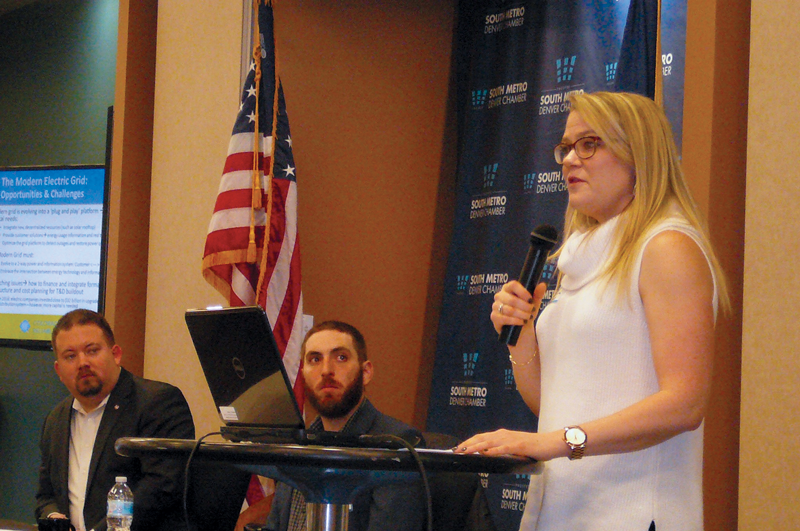
Oil and gas, as well as solar and wind, were on the grid Feb. 9 when the chamber’s Economic Development Group presented “The Future of Energy in Colorado,” a panel discussion that made clear that the “future” would be an all-of-the-above marriage of mutual interest.
Even the oil and gas industry uses solar power, said Mark Truax, the operations director for Coloradans for Responsible Energy Development.
“When we are out in the field and we have our well heads and things of that nature, almost all of them have a solar array,” he said. “They rely on us. We rely on them.”
Although solar is often coupled with a decidedly off-the-grid attitude, that industry is anything but disassociated from traditional sources of electricity.
“We rely on the grid to make it work right now,” said Aaron Weissman, a senior sales consultant with Auric Solar. “The technology is not anywhere close to where we need it to be [to] not need that power grid.”
The grid—or more specifically, Xcel Energy—acts as a sort of storage bank for the excess output of its customers’ solar panels. Without it, a customer’s solar energy would have no place to go while the customer was not at home—and that customer would not have the benefit of effectively saving those credits for a cloudy day.
Alanna Fishman of Coloradans for Reliable Electricity is also a spokeswoman for Xcel. She said coal, natural gas and renewables all play an important role.
“We’re really able to utilize all those resources in an order that’s called ‘merit order,’ which means the full resources that are the lowest cost to customers are the ones that are put on the grid first,” she said.
Fishman also noted the inevitable intersection of energy sources.
“Even though renewables do not use any kind of fuels to make them work—solar panels use sun, wind turbines use wind—they still use natural gas and oil to build those parts,” she said.
Much of that comes by way hydraulic fracturing, or fracking, the often-controversial process by which underground rock is ruptured by pressurized liquid to extract natural gas and petroleum.
“After the flowline inspection was mandated by the government … over 90 percent of flowlines in Colorado passed inspection,” Truax touted. “When you think about the hundreds of thousands of flowlines that were inspected, that is a remarkable number. … We have to get the oil and gas out of the ground. We know that, but we also have to make sure we’re being responsive as companies to the municipalities and the development.”
While the oil and gas sector continues its technological innovations, the electrical grid is undergoing its own renovations—as best it can—with available political energies.
“Every year, $100 billion is put towards building or updating our energy infrastructure. … It’s not really enough,” Fishman said. “There is so much infrastructure that needs to be updated.”
On the bright side—quite literally—Colorado’s sun is in pretty good shape.
“It’s a really great place for solar,” Weissman said of the state. “We get some of the most sun in the country. In addition to that, it doesn’t get too hot in the summertime, which increases the lifespan of the [solar-panel] system.
The unspoken word for most of the forum was “nuclear,” until the end when moderator Doug Tisdale slyly suggested that the subject might be a little too “radioactive.”
“It’s such a critical part of the energy world,” Fishman said once the laughter subsided. “Building it and developing it are slow for two big reasons—one, its expensive. … The second reason is people are scared of it, and they have a right to be.”