The medium and the message
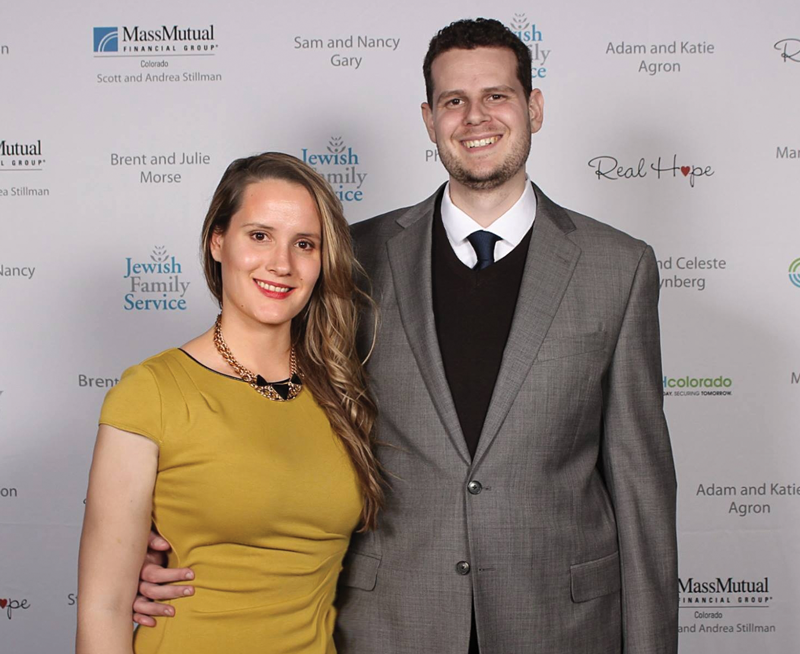

Michael Sharon and wife Dana attend the “premiere” of one of 6162’s videos at a fundraising event for Jewish Family Services. Photos courtesy of 6162 Productions
Filmmaker uses his camera to tell the compelling stories behind nonprofits
BY PETER JONES
NEWS EDITOR
As a kid growing up in Greenwood Village, Michael Sharon would often have his eye on the lens, capturing anything that moved on film, video or digital data.
“As soon as I got a camera in my hands, it was like this feels very natural to me,” he said.
By the time Sharon was 13, his natural third eye was producing films that would play Denver’s onetime Starz Film Center and capture the attention of The Villager in a feature story.
“I had a huge fascination with espionage and spy stuff,” Sharon said. “I basically wrote a 50-minute movie script and recruited a bunch of my neighbors, friends and family and filmed it over the course of a couple months. I taught myself how to film and edit.”
After graduating Cherry Creek High School, where he served as president of the film club, Sharon received more formal training at Colorado Film School, where he realized that the industry he loved was not always a bastion of glitz and creative freedom.
“I originally had maybe the idea that I would go out and try the Hollywood approach,” he said, “but as I was going through film school, LA didn’t seem too appealing—a lot of politics, a lot of corruption in that city and system. So, I tried to find another way.”
Sharon’s search for the right angle—camera and otherwise—came after thinking through what he truly loved about the art of telling stories on film.
“From a really young age, I wanted to make narrative films and documentaries around human interest and try to spread the message of people in a positive light. I didn’t know exactly what it would look like for my career,” he said.
The answer came in 2013 with the founding of Sharon’s 6162 Productions, a company that combines the filmmaker’s penchant for filmmaking with his intrinsic love for positive people stories—but this time with a purpose that went beyond “feel good” movies.
What if Sharon could tell stories that could literally help people by making compelling fundraising films for charities, nonprofit organizations and mission-driven organizations?
So many of the charity promotional videos Sharon had seen before emphasized fancy graphics, talking heads and the 5,000-foot views of CEOs. What if these groups used actual filmmaking technique—story arcs, character, conflict, even flashback—to tell their stories?
“We talk about the human approach by really highlighting specific client stories within the organization, as opposed to stacking numbers and statistics,” he said. “We’re trying to get more heartfelt emotions and then bring it back to the organization as a whole. A lot of videos we do are focused on one person’s story and how the organization touched their life.”

6162, the company that brought the idea to life, was named for Sharon’s childhood street address in Greenwood Village, the place where the young filmmaker’s healthy imagination first took root in the backyard with makeshift sets and neighborhood casting.
“I wanted it to be more personal, and that was the address where I started my whole career, so I thought it was a nice homage to that,” he said.
Now based in both Denver and Seattle, 6162 has produced videos for nearly 30 organizations. Many are played on the screen at fundraising events and on social-media platforms. The firm’s rates are based on the size of the organization, its budget and other factors.
South metro clients have so far included Jewish Family Services and Greenwood Village’s Courageous Faces Foundation, an organization that assists people whose faces have been touched by birth defect, disease or tragedy.
6162’s video for Courageous Faces told the story of one man whose rare condition resulted in tumors all over his body.
“He is just the nicest guy and just a person at the end of the day,” Sharon said. “We told his story on camera and shared all the hardships of being outcast socially. He got really emotional with how much the organization had helped him with feeling more comfortable. They made a customized suit for him where his tumors were. That was the first time any clothing really fit him properly.”
Given the choice of contracting with more traditional corporate clients, Sharon, 29, says he gets much more satisfaction by working with mission-driven organizations.
“It seems like nonprofits give us a little more creative freedom and they have a lot more interesting stories,” he said.
Although Sharon is committed to his short-form niche, he recognizes that some of the stories he is telling could eventually become fodder for full-length documentaries in their own right, an expansion idea that remains on the backburner for the time being.
“I want to get these messages out there however that can be achieved,” he said. “Right now, this seems like the best approach.”