

State budget official warns of ‘deep trouble’
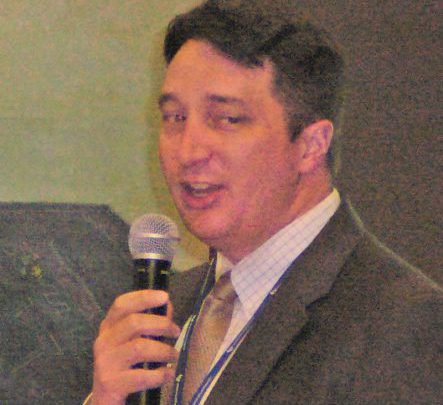

Deputy director talks ‘crisis’ at University of Phoenix event
BY PETER JONES
NEWS EDITOR
Colorado’s budget may be a ticking time bomb, to hear Erick Scheminske tell it.
“Hopefully, we can solve this problem before it becomes a crisis, but my suspicion is the problem will become a crisis before the voters decide that it needs to be solved,” the deputy director of state planning and budgeting said to an audience last week.
One way or another, education would likely be on the chopping block, the official told a University of Phoenix luncheon March 31 at Madden Museum of Art at Palazzo Verdi in Greenwood Village. The probable victim: Either K-12 or higher education.
Scheminske, whose office coordinates Gov. John Hickenlooper’s proposed budgets, predicted that annual funding to Colorado’s public universities would be cut by more than 50 percent if the state does not fix constitutional wrinkles in state-revenue policy.
“You would look at CU and CSU likely becoming privatized institutions altogether,” he said.
According to Scheminske, the problem is in large part rooted in complications surrounding the Taxpayers Bill of Rights or TABOR, the amendment to the Colorado Constitution approved by voters in 1992. It requires that increases in overall tax revenue be tied to inflation and population increases, unless larger increases are approved by voters.
TABOR’s often complicated effects have worked—in concert or conflict—with the Gallagher Amendment, passed a decade earlier, that effectively keeps residential property taxes “artificially” down, in Scheminske’s words.
“Colorado has probably the most complex revenue and expenditure structure of any state in the country. All of these competing interests are starting to collide,” he said.
In the interest of continuing to fund education, human services and other programs, state officials have sought workarounds. While a controversial fee paid by hospitals has helped meet the state’s Medicaid responsibilities and has resulted in matching federal funds, that revenue has run afoul of TABOR’s tax-limitation provisions by the hundreds of millions of dollars.
“It’s pushing us over our overall TABOR limit,” Scheminske said, noting those overages have required refunds to taxpayers, even though it is hospitals that pay the fee. “This has been a very, very challenging experience for us in the last few years.”
What’s more, the same state Constitution that mandates TABOR refunds also requires increased K-12 funding, even as Colorado’s Medicaid bill rises. Meanwhile, the state’s gas tax— last increased in 1992 when vehicles were less fuel efficient—is still calculated on a stagnant per-gallon rate, regardless of gas prices and increased wear and tear on the roads.
“Our government right now is bigger than our britches. We just don’t have enough revenue coming in to fund everything,” Scheminske said. “… You can’t continue to have a system like we have that on one hand requires revenue reductions and on the other hand requires spending increases. The citizens of Colorado are going to have to make a fundamental change.”
That transformation can be delayed for a while, according to the official, but not indefinitely.
“If we do stay on this path, we’re in deep trouble the next time we have a recession,” he said.